

A guide for creatives, job seekers, and changemakers to craft a personal narrative that connects emotionally.
We all know the feeling. You sit down to write an “About Me” section for your website, a LinkedIn bio, or an introduction for a speaking gig—and what comes out reads like the back of a résumé. Bullet points. Job titles. Degrees. Dates.
But here’s the thing: no one connects with a résumé. They connect with a story.
Your personal narrative isn’t just a list of what you’ve done—it’s why it matters. It’s the thread that ties together all the jobs, projects, and pivots into something meaningful.
This post will help you shift from bullet points to storytelling so you can write about yourself in a way that sticks.
1. Find Your Throughline
Think of your story like a movie plot—there’s a main theme tying everything together.
Maybe it’s curiosity. Maybe it’s resilience. Maybe it’s a passion for helping people solve problems.
Ask yourself:
- What’s the common thread running through all the jobs or projects I’ve taken on?
- What do I care about enough to follow across industries or roles?
Example: Instead of saying, “I’ve worked in marketing, library science, and nonprofit development,” you might write:
“I’ve always been drawn to work that connects people—to stories, to resources, and to each other. That’s taken me from library stacks to marketing campaigns to mission-driven nonprofits.”
2. Start With the “Why,” Not the Job Title
A résumé says what you did. Your story explains why.
Instead of:
“I was a Marketing & Administrative Director at a nonprofit.”
Try:
“I’ve always believed good ideas deserve an audience, so I took on roles where I could build awareness for causes that matter—most recently as Marketing & Administrative Director for a clean energy nonprofit.”
Leading with your “why” gives readers an instant emotional connection—they see the purpose behind the positions.
3. Share a Moment, Not Just a Milestone
Stories are built on moments—the day you made a big decision, the spark of inspiration that changed your direction, the challenge that tested you.
Your résumé says you “launched a campaign.” Your story tells us why that campaign mattered, or the moment you realized it was working.
“When a landlord called me in tears, telling me our outreach had helped her keep her tenants during COVID, I realized marketing isn’t just about numbers—it’s about people’s lives.”
Those moments are what stick.
4. Be Conversational (But Not Casual)
Your narrative should feel like you’re talking to someone over coffee—not reading your job history aloud.
- Use first person (“I,” “my,” “I’ve learned”)
- Write in short, clear sentences
- Skip jargon unless you’re explaining it
Think of how you’d explain your journey to someone curious—not someone grading your homework.
5. Leave Room for What’s Next
The best personal stories don’t just explain how you got here—they invite the reader to imagine where you’re going.
Instead of ending with your most recent role, add a forward-looking note:
“Now, I’m focused on bringing those same storytelling skills to organizations tackling climate change and community resilience.”
It signals growth—and it’s a subtle call to action for the opportunities you want.
Putting It Together
Here’s a before-and-after example:
Résumé-style intro:
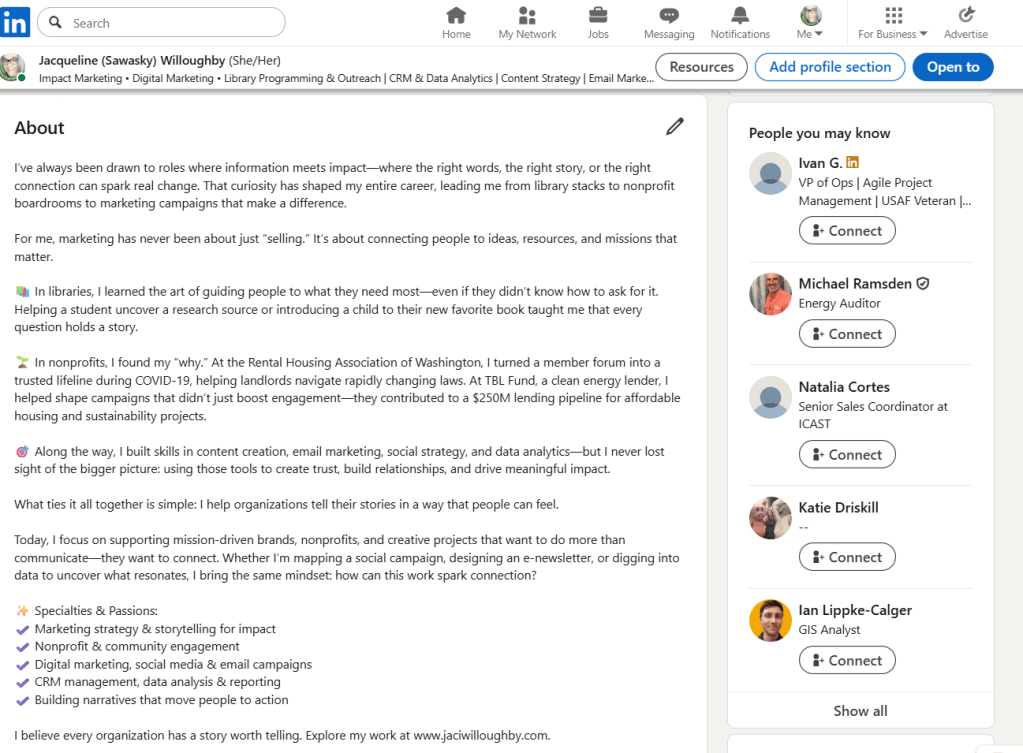
“I have 15+ years of experience in marketing, communications, and nonprofit work. I’ve held positions including Marketing Director, Membership Specialist, and Library Associate, and I hold a Master’s in Library and Information Science.”
Story-driven intro:
“I’ve always been drawn to roles where information meets impact—where the right words or ideas can change someone’s life. That’s taken me from helping library patrons find their next favorite book to building marketing campaigns for nonprofits tackling clean energy and housing. Today, I use that same curiosity and care to help mission-driven organizations share their stories and grow their reach.”
One reads like a list. The other reads like a person.
Final Thought
Your résumé might get you the meeting—but your story is what makes people remember you.
The next time you write an “About Me” or prepare for an interview, don’t just list titles. Share the why, the moments, and the thread that runs through it all.
Because when your story connects emotionally, the bullet points become unforgettable.
 Jacqueline Willoughby